
Questions?
(800) 621-5381
(800) 621-5381
Answer a couple of plain-language questions and get matched to the exact NDS permeable paver you need — grass or gravel, roll or rigid panel — with live pricing and a one-click, cart-ready parts list.
Choosing permeable pavers sounds simple until you are weighing a grass surface against a gravel one, a 150-foot roll against a small pad, and a light residential driveway against an H-20 fire lane. The Permeable Paver Selector above walks you through what you are paving, whether you want a grass or gravel surface, and how much load it has to carry — then matches you to the exact NDS product we stock, shows live pricing, and builds a cart-ready parts list. It is made for contractors who already know the spec and for first-time buyers who would rather be guided than guess.

Permeable pavers are a load-transferring grid or panel system that stabilizes a grass or gravel surface while letting stormwater drain straight through instead of running off. The honeycomb or webbed cells confine the fill material — turf for grass pavers, crushed stone for gravel pavers — so that a driveway, parking area, or access road stays firm and drivable yet remains permeable. Done right, the surface resists rutting and washout, supports vehicle loads, and helps a site manage stormwater on-site rather than shedding it to the street.
The first decision is the type of paver, because it determines how the surface looks, how it is filled, and how much load it can carry:
Reinforce turf so it can take occasional traffic. Cells hold soil and let grass grow through for a green, natural surface. Available in roll form for fast installs.
Confine crushed stone in a roll-out grid with attached fabric. A firm, road-like surface that resists rutting and stays permeable. Great for driveways and lanes.
Interlocking 2' x 2' panels rated to 81,744 psf — strong enough for fire trucks and heavy equipment. Works with either grass or gravel fill.
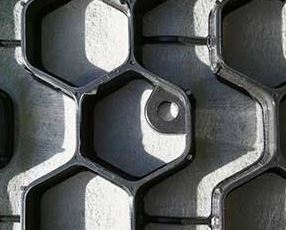
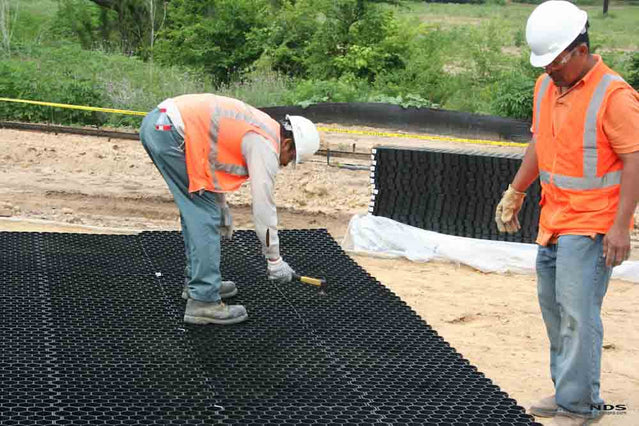
If you take away one idea, make it this: grass pavers are for a green surface where turf grows up through the cells, while gravel pavers are for a firm stone surface where crushed gravel is locked into the cells. Both are permeable and both transfer vehicle weight down to a compacted base, but they create very different finished looks. Grass pavers suit overflow parking, fire lanes through landscaping, and turf areas that occasionally see vehicles. Gravel pavers suit driveways, parking lots, trails, and access roads where you want a stable, drivable stone surface that does not rut, wash, or migrate the way loose gravel does.
A rigid cellular grid is laid over a compacted aggregate base. The cells confine the fill and transfer vehicle loads down to the base course instead of letting tires displace the surface. At the same time, the open cell structure — and, on the gravel roll, an attached geotextile fabric — lets water infiltrate through to the ground rather than pooling on top or running off the edges. That combination is what makes the surface both drivable and permeable. The fabric on the EZ Roll gravel paver also separates the stone from the soil below, so the fill does not sink and disappear into the subgrade over time.
Pick the product to the heaviest vehicle the surface will see. The two EZ Roll systems carry a compressive strength of 57,890 psf when empty, which covers the great majority of residential and light-commercial uses. For fire lanes, loading docks, and anywhere an H-20 vehicle such as a fire truck must travel, the rigid TuffTrack panel steps up to 81,744 psf.
| Product | Form | Strength (empty) | Best for |
|---|---|---|---|
| EZ Roll Grass Paver | 4' roll | 57,890 psf | Turf parking, fire lanes through landscaping, green overflow areas |
| EZ Roll Gravel Paver | 4' roll | 57,890 psf | Gravel driveways, parking, trails, and access roads |
| TuffTrack Panel | 2' x 2' rigid | 81,744 psf | Fire trucks, H-20 loads, heavy equipment routes |
Two questions decide your order: will it carry the load, and how much do I need? For base depth, a common minimum is a 6-inch compacted aggregate base for cars and light trucks and an 8-inch base for heavy loads like fire trucks, with grade limits depending on the load. Poor soils or repeated heavy traffic usually justify more depth. For coverage, an EZ Roll gravel paver roll covers about 577 square feet and the small 4' x 24' grass roll covers about 96 square feet. Divide the area you are paving by the coverage per roll, then add a small allowance for trimming and overlap.
As a worked example, a 12-foot-wide by 80-foot-long gravel driveway is 960 square feet. At roughly 577 square feet per roll, you would plan on two rolls plus a small trim allowance, over a 6-inch-plus compacted base, filled with clean angular stone.
Once the grid is installed and filled, EZ Marker domes snap into empty cells to lay out parking stalls, drive lanes, and fire lanes — no paint or striping needed. They are especially useful on overflow and event parking where you want clear guidance on a gravel or grass surface. EZ Markers are an add-on for a paver order, so when you build a match in the selector above you can add them right alongside your pavers.
Treat the job like a roadway section: excavate to depth, compact the subgrade, build and compact the aggregate base in lifts, then roll out the pavers with the fabric side down and anchor them so they do not shift during filling. Fill the cells with clean, angular stone (rounded pea gravel tends to migrate) — a common target is 3/8-inch clean crushed gravel — and top off so the grid is fully supported. Contain the edges with edging or a border to keep the surface tight over time, and the finished result drives like pavement while still looking like gravel or turf.
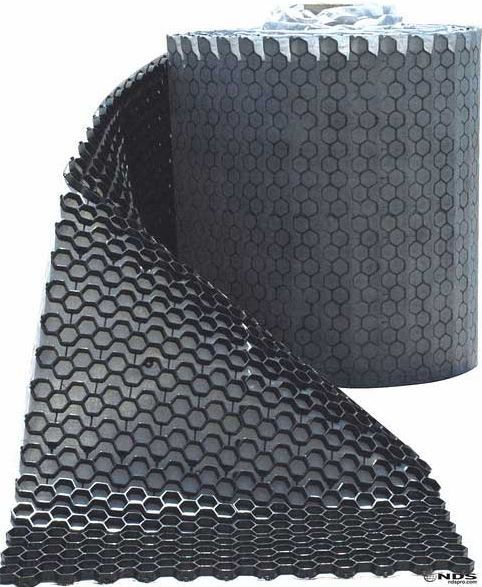
Roll-out honeycomb grid with attached fabric. ~577 sq ft per 4' x 150' roll. Black, gray, red, tan.
Shop Gravel Pavers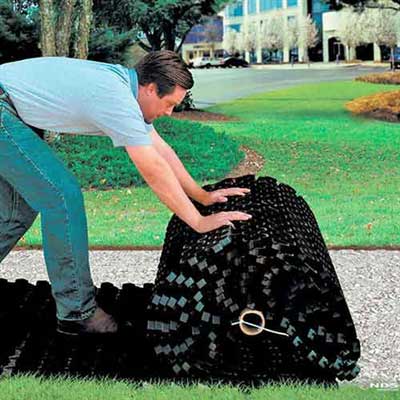
Turf-reinforcement grid for a green, drivable surface. Available in 4' x 24' and 4' x 150' rolls.
Shop Grass Pavers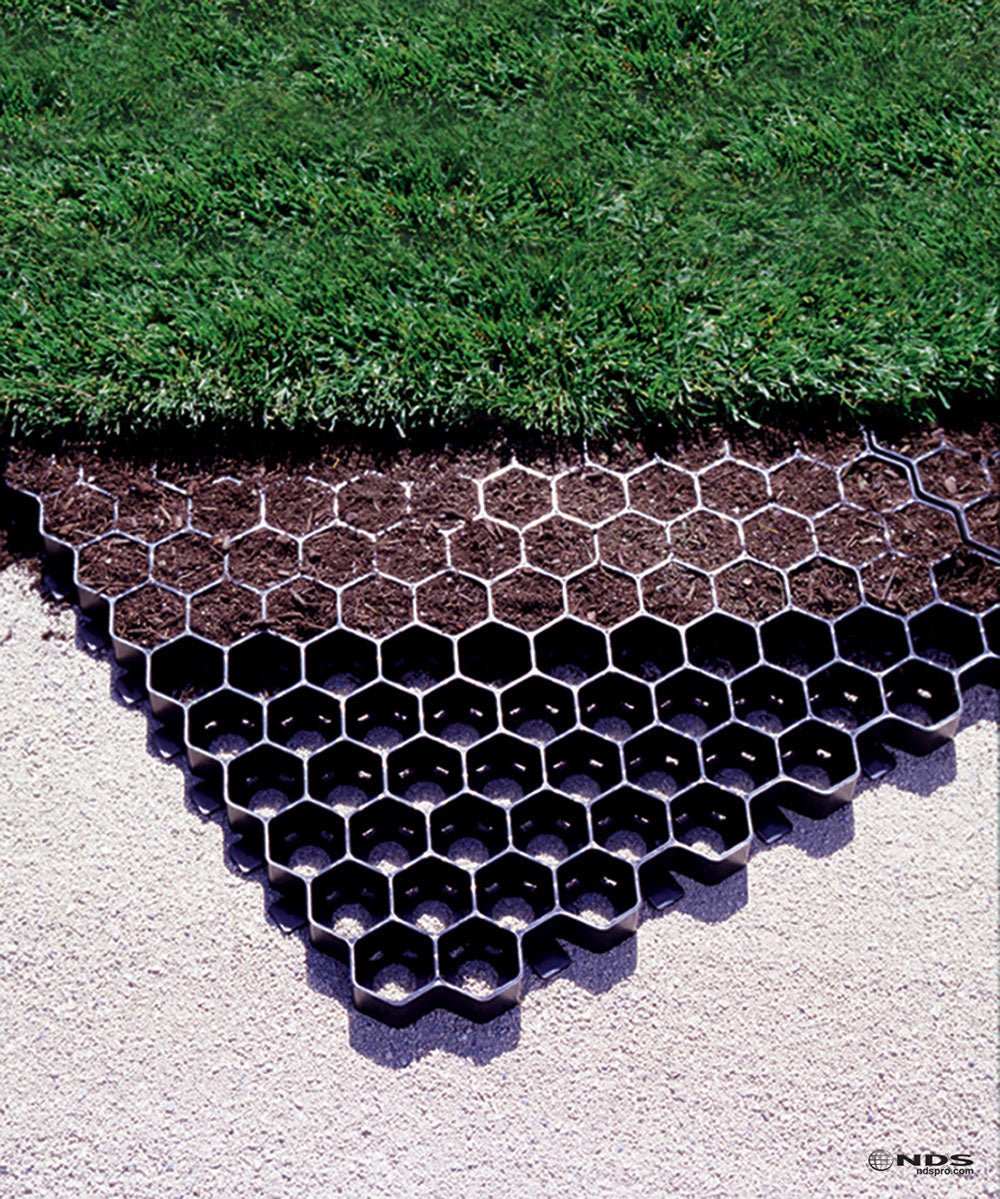
Rigid 2' x 2' panels rated to 81,744 psf for fire trucks and heavy loads. Grass or gravel fill.
Shop TuffTrackPermeable pavers are a load-transferring grid or panel system that stabilizes a grass or gravel surface while letting stormwater drain straight through instead of running off. Honeycomb or webbed cells confine the fill — turf for grass pavers, crushed stone for gravel pavers — so a driveway, parking area, or access road stays firm and drivable yet remains permeable.
Grass pavers hold soil and let turf grow up through the cells for a green, natural-looking surface that still supports vehicles. Gravel pavers confine crushed stone in the cells for a firm, road-like finish that resists rutting and washout. Both are permeable; the choice comes down to whether you want a green surface or a stone surface.
A rigid cellular grid is laid over a compacted aggregate base. The cells confine the fill and transfer vehicle loads down to the base course instead of letting tires displace the surface, while the open structure and attached fabric let water infiltrate through to the ground below rather than pooling or running off.
A common minimum is a 6-inch compacted aggregate base for cars and light trucks and an 8-inch base for heavy loads such as fire trucks (H-20), with grade limits depending on the load. Poor soils or repeated heavy traffic usually justify additional base depth. The base build is what turns the grid into a road-ready surface.
An NDS EZ Roll gravel paver roll (4' x 150') covers about 577 square feet, and the 4' x 24' grass paver roll covers about 96 square feet. To estimate rolls, divide the area you are paving by the coverage per roll and add a small allowance for trimming and overlap.
Permeable paver systems are designed to let water infiltrate, so they are generally treated as permeable rather than impervious in stormwater calculations. Local jurisdictions vary in how they credit them, so confirm with your local stormwater authority for your specific project.
Use the Permeable Paver Selector at the top of this page to get a product match, see current pricing, and build a cart-ready parts list. Prefer to talk it through? Our team specs paver projects with contractors every day at (800) 621-5381.
Use the Permeable Paver Selector